What Is Social Selling and How to Use It

Scott Porter

Check our what social selling is and how to use it in 2021

It’s no secret that the introduction of social media in business has changed the game. But has your company caught up with these industry changes? It can be hard to adapt your selling style especially on social media, but the opportunities that come with it are more than worth it. Social selling is the new era of sales tactics that appeals to millennial buyers. Read here exactly what social selling means, why it’s important and how to start trying it out now. 

What is Social Selling?

Social selling is about leveraging your social network to find the right prospects, build trusted relationships, and ultimately, achieve your sales goals. This sales technique enables better sales lead generation and sales prospecting process and eliminates the need for cold calling. Building and maintaining relationships is easier within the network that you and your customer trust.

Why Social Selling is Important

You may still be wondering why social selling is important? Well, research says 91% of B2B buyers are now active and involved in social media. And among B2B professionals specifically, 39% said they were able to reduce account research time with social selling tools. We understand that not every sales rep sells the same or that companies have a certain way of doing business, but check out the other benefits to social selling here:

  • Builds better relationships with customers.
  • More deals closed. 78% of social sellers outsell peers who don’t use social media.
  • Monitor and stay ahead of competitors.
  • Appeal to younger audiences. 
  • A strong social media presence will legitimize your business.
  • Improve advertising for you and your business.
  • Contact your prospects in a more direct and personal way.

How to Start Selling With Social Media

It’s obvious now that social selling works, so how do you start selling that way? Here are some of the first steps you can start today to start selling on social media:

  1. Choose relevant social media platforms for your business. Instagram, Linkedin and Facebook are among the most popular, but others find success on TikTok and Twitter too.
  2. Create a wishlist of companies and start following them.
  3. Join and participate in Linkedin groups.
  4. Contribute to conversations and reviews about your brand to show that you truly care what your customers are saying.
  5. Find and create platforms to share relevant content. Blogs and social media are both great ways to share information about your products and participate in online discussion.

These are just some of the first steps you can take to bring a positive presence for your business to social media. It may be scary to start selling your products in a way you never had before, but the key to being successful in social selling is to focus on showing your customers that you’re there, you care, and you can adapt to the times and be there for their pain points through the years.

Start following these steps now and see what it can do for your business. As always, if you need help improving your sales process before advertising it more, schedule a free demo with us now so we can help!

Automate More With the New Tray.io Integration

Diana May-Jennings

Set up the Tray.io integration in 4 easy steps

Tray.io is a platform where you can integrate your entire stack with the leading general automation platform. Tray.io allows you to do more, faster with clicks-or-code by focusing on automation as the newest growth for companies. With this integration you can quickly integrate your software applications using powerful automated workflows and easily build and streamline processes using their beautifully designed visual workflow editor.

What does this integration do?

  • Pushes and pulls data to and from SalesRabbit

What data is transferred into Tray.io?

  • Handling of Users and Leads
  • Webhook/Triggering Functionality
  • First Name
  • Last Name
  • Phone
  • Street Address
  • Apt/Suite
  • City
  • State
  • Postal Code
  • Custom Fields

Integration Set Up

Tray gives you the ability to build a custom integration. Essentially it is a building block not a fully built out integration. To use a Tray connector you will need to build out the connector to your liking, and then add your SalesRabbit API token.

Step 1. Generating your new API Token:

Access the SalesRabbit web app (app.salesrabbit.com) and go to Integrations > API.
Click on the “API Token” button.

Step 2. Renaming your token:

You will want to rename your a created token to keep track of what it connects to. Click on your newly created token and rename it. (ex. Tray.io API Token)

Step 3. Authenticating Tray to your SalesRabbit Account

Note: “In order to Authenticate the account on Tray, you will need to add your newly created API token from SalesRabbit. You will want to enter the API token as the “Access Token“.

The following are screenshots from a Tray integration:

Step 4. Build out the remainder of your Tray integration

Go through the remainder of the steps, customizing what you want your Tray connecter to do.

Access More Integrations

If you’re interested in using any of these powerful integrations, any and all of these integrations can be set up through our Help Center portal, the Integration Marketplace or by reaching out to your account CSM or support team at support@salesrabbit.com 801-418-9009.

8 Ways to Host a Great Sales Kickoff Meeting

Sean Huckstep

Check out 8 Ways to Host a Great Annual Sales Kickoff Meeting

Professional teams, especially sales teams thrive when they’re aligned and fired up about their team goals. If you haven’t decided a great way to set the tone for an entire team yet, consider hosting an annual sales kickoff. These types of meetings are a fun and engaging way to break up the routine of work and get your sales team invested in the next 12 months. See why kickoff meetings are important and tips for hosting your own below.

What are Sales Kickoffs and Why are They Important?

A sales kickoff meeting is an event, usually held annually, designed around bringing your entire sales team together to celebrate past successes, lay out your strategy, and share best practices. Sales strategy meetings are a great way to create strategic alignment across sales teams for goals, market strategies, areas for improvement, and focus on particular skill sets for the year.

Kickoff meetings are important because they encourage your team to build unity and include them more specifically in the goals you want your sales team to achieve. Check out how to make these meetings successful down below.

Tips for Hosting a Kickoff Meeting

Hosting an annual sales kickoff can look different for various sales teams and industries. But here are 8 guaranteed ways to make sure your meeting is successful and helpful to the development of your sales team. Use any or all of these tips to make sure you’ll achieve the results you want with your meeting.

  1. Choose between a day or overnight meeting. These kickoff meetings can be a 2 hour meeting or a multi-day experience depending on how much time you want to spend and what you want to cover as a team. We suggest an overnight trip to see how your team functions for a longer period of time outside of work.
  2. Venture beyond the office. Offsite meetings somewhere local or even further can be a great way to build more team unity outside of the normal day-to-day setting.
  3. Choose what time of year is best for your team. Depending on your selling season or industry, the best time of year for your kickoff may look different. For example, companies that do summer sales will do this but at the beginning of summer to really gear up for the busy season but many teams start the year off with their kickoff in January.
  4. Create a detailed agenda. You want to make the most of your time during these meetings, so creating an agenda will keep you organized and productive the entire time.
  5. Make it fun! Depending on where you choose to have your kickoff, you should include plenty of fun, non-work related activities to have fun as a team. This will result in everyone becoming closer and forming friendships that go beyond work.
  6. Use this as a teaching opportunity. Being with your team for an extended period of time is a great opportunity to teach and coach your reps on parts of the sales process your team may be lacking in based on previous data. Be sure to explain what you’re wanting the team to work on and why based on actual numbers or experience. This can be done as a team and broken down into a person-to-person lesson as well.
  7. Include input from the whole team. While it is important to have goals pre-determined as the manager or sales lead, make sure you allow the whole team to provide input on the yearly goals so they’re more invested in making it a strong year as well.
  8. Choose an applicable theme. Sales kickoff themes are a great way to focus the activities, goals, or plans you’ll be making. Here are some ideas we like: “Level Up” “Raise the Bar” “Next-Level” “No Limits” that you can use.

Start Planning Your Kickoff Now

What do you think about these tips? If you haven’t hosted a sales kickoff meeting, now is the perfect time to plan ahead and host one coming in January 2022. If your workplace is concerned about safety with Covid-19, virtual kickoff meetings are becoming more popular and are still a great alternative to an in-person meeting. What is your next sales meeting going to look like? Comment down below.

15 Inspirational Podcasts to Follow

Scott Porter

Check out 15 of the best podcasts out there!

Podcasts have recently become a popular way to get a quick dose of motivation on your way to work, the grocery store, or while on a walk through the neighborhood. For those of you that don’t enjoy reading or don’t have the time to sit down and read, podcasts are a great solution to gain knowledge, inspiration, and life improvements on the go. Apple, Amazon, HubSpot, and NPR are just some of the resources you can use to find great podcasts like these 15 that we’re sharing with you.

15 Work and Life Inspirational Podcasts

There are a lot more where this came from, but these are just some of the podcasts we use at SalesRabbit and have been recommended by other motivated people. Let us know what you think and which of these speaks to you the most.

  1. TED Talks: TED talks on YouTube have always given a lot of knowledge and inspiration to better your life and now they’re in daily podcast form!
  2. Weekly Motivation by Ben Lionel Scott: Here you’ll find weekly motivation from some of the most successful and high achieving people in the world to help encourage you through your journey in life.
  3. Jocko Podcast: Jocko Willink is a decorated retired Navy SEAL officer and author that now shares his experiences, advice, and inspiration with various guests.
  4. We Can Do Hard Things with Glennon Doyle: Author Glennon Doyle made a podcast out of the mantra “We Can Do Hard Things” that saved her life and gave her a new found purpose.
  5. How I Built This with Guy Raz: Guy Raz dives into the stories behind some of the world’s best known companies. How I Built This weaves a narrative journey about innovators, entrepreneurs and idealists—and the movements they built.
  6. The LEADx Leadership Show with Kevin Kruse: Kevin Kruse interviews top leadership experts and business executives to help you accelerate your career and reach your full potential.
  7. Super Soul: Awaken, discover and connect to the deeper meaning of the world around you with Super Soul. Hear Oprah’s personal selection of her interviews with thought-leaders, best-selling authors, spiritual luminaries, as well as health and wellness experts.
  8. The School of Greatness: Lewis Howes is a New York Times best-selling author, 2x All-American athlete, keynote speaker, and entrepreneur. The School of Greatness shares inspiring interviews from the most successful people on the planet—world-renowned leaders in business, entertainment, sports, science, health, and literature to inspire you to unlock your inner greatness and live your best life.
  9. My First Million: Sam Parr (@theSamParr) and Shaan Puri (@ShaanVP) discuss how Brumate, the company that scaled to $20M without a single employee, is helping influencers discover what they’re truly worth, how to do an energy audit, and much more.
  10. The Sakita Method: The Sakita Method podcast is hosted by Sakita Holley, an award-winning publicist and entrepreneur who gives you direct, unfiltered access to your favorite creatives, entrepreneurs and executives and the methods that have made them successful.
  11. Wisdom From the Top with Guy Raz: From the creator of How I Built This, host Guy Raz invites you to listen in as he talks to leadership experts and the visionary leaders of some of the world’s biggest brands. Along the way, you’ll hear accounts of crisis, failure, turnaround, and triumph, as the leaders reveal their secrets on their way to the top. These are stories that didn’t make it into their company bios, and valuable lessons for anyone trying to make it in business.
  12. Metrics & Chill: Metrics & Chill is a podcast about business metrics and the interesting and creative ways people improve them. Think of this show as your swipe file for discovering new and innovative ways for moving the numbers.
  13. Smartless: “SmartLess” with Jason Bateman, Sean Hayes, & Will Arnett is a podcast that connects and unites people from all walks of life to learn about shared experiences through thoughtful dialogue and organic hilarity. A nice surprise: in each episode of SmartLess, one of the hosts reveals his mystery guest to the other two. What ensues is a genuinely improvised and authentic conversation filled with laughter and newfound knowledge to feed the SmartLess mind.
  14. Freakonomics Radio: Discover the hidden side of everything with Stephen J. Dubner, co-author of the Freakonomics books. Each week, Freakonomics Radio tells you things you always thought you knew (but didn’t) and things you never thought you wanted to know (but do) — from the economics of sleep to how to become great at just about anything. Dubner speaks with Nobel laureates and provocateurs, intellectuals and entrepreneurs, and various other underachievers.
  15. Teamistry: Teamistry is the chemistry of unsung teams that achieve the impossible. New episodes every other Monday. Teamistry is hosted by award-winning documentary and feature film director Gabriela Cowperthwaite.

What are you listening to? Share some of your favorite podcasts below!

5 Presentation Hacks to Improve Your Sales Deck

Diana May-Jennings

Use these 5 hacks to create an awesome sales deck

Sales decks are a great resource for sales reps that are pitching to a new customer. Whether you already have one or you’re looking to learn more about what they are and what they do, we talk about what a sales deck is, why it’s important, and share 5 tips that we find useful when creating or editing a sales deck to make it more effective. Check out everything you need to know about sales decks now!

What is a Sales Deck?

A sales deck is a slide presentation (e.g., PowerPoint, Keynote, etc.) used to supplement a sales pitch. A sales deck shown by a salesperson to a prospect often includes an overview of the product or service, offers a value proposition and solution for the prospect, and includes examples of success stories from other clients.

Why is it Important?

The purpose of a sales deck is to supplement your sales pitch in a way that provides the potential customer with everything they need to know about your company and product. Ideally, this will lead to them confidently purchasing from you.

5 Tips for Creating a Superior Sales Deck

There are a lot of ways you can go about making a sales deck. Some prefer PowerPoint, while others take another approach with Keynote or Prezi. No matter the program you use to make your sales deck, there are some hacks and tricks you can use to make sure it’s a strong, valuable asset to your overall pitch to the customer.

    1. Create a useful overview. Customers want to know how your service can make their lives easier so the first thing you want to do is introduce a common problem, followed by a value proposition, and finally a solution that your services provide. Richter is a perfect example of making their opening statement a relatable problem that their customer is going to have. This gets the customer initially hooked when they segway into their proposition and solution.
    2. Have a strong brand identity. Using the same colors, logo, and theme the entire sales deck is a great way to make it look clear, professional, and stylish. Salesforce does a great job of using the same colors and font throughout their entire sales deck. They don’t need to be flashy to get their point across, they remain sleek and professional which is more appealing when making sales decks.
    3. Keep it straightforward. Whether you include 5 slides of 20, as long as you’re covering information that is clear, relevant, and useful to the potential customer it will be well received. LeadCrunch presents a common and basic sales deck that is ideal for a customers to digest despite it being 21 slides.
    4. Have a strong opening statement backed by data. Using a bold statement like “Snapchat is the best way to reach 13 to 34 year-olds.” This is a clear purpose that Snapchat serves which they then back up with research and data points.
    5. Focus on information the customer wants to hear and less about your accomplishments. It’s great to prove that you’re a great rep or company, but all the customer really cares about is what you’ll do to help them and why they should give you money. So make sure to always connect what you say to what’s relevant for them. We all know Tumblr, in their sales deck they focus less on slides and more on straightforward content that the customer wants to hear. 

What Will Your Sales Deck Look Like?

We gave you 5 presentation hacks to improve your sales deck, so which of these do you find most valuable? Have any of these affected your sales deck if you already have one? If you’re struggling with where to start, check out a bunch of the presentation and proposal tools that SalesRabbit has to make sure your sales deck and pitch are ready for customers.

Tips For Managing Sales Leads

Brady Anderson

Managing leads more efficiently in the Android and iOS Apps

Lead management is an essential part of being successful in sales. Without a way to organize and find your leads, your sales process won’t be nearly as effective as it should be. If you struggle with finding your leads, changing ownership, or setting appointments for your leads we’ve got the solutions below, check them out.

How to Find Your Leads in the iOS App

To locate your created leads in the iOS app, check out this video and follow the steps below.


To access the Lead Search, click “Sales Hub” within the lower legend of your screen.

At the top of the screen, click the word “Leads.”

Here, you will see a list view of all Leads that populated based on your filters. (For a review of how filters work, watch the video above.)

At the top of the screen, there is a blank field that allows you to “Search.”

In this example, we are searching by “Lynn.” Please note, “All” is applied to the right.

In this example, we are looking for a person named Lynn rather than a street. To the right of the search field, click the downward arrow to the left of “All.” All the fields we are able to search by are available. In this case, we click on “First Name.”

Now that we have the search narrowed down by first name…

…we are able to click on the name to go into the lead:

Or, going back to the search (red arrow in upper left hand corner of the Lead Detail page), we may click the map icon to the far right of the lead.

Clicking the map icon will take you to the physical location of the lead on the map.

Finally, going back to the “Leads” tab at the top of the screen, once the search is cleared out, you have the option to sort the leads by clicking the descending lines in the upper right hand corner.

Here, you may sort the filtered leads by Name, Distance, or Appointment from Ascending order or Descending order. In this case, it is most effective if your Filters have been narrowed down by date and Lead Status type, as shown in the example below:

Stats and Appointments

On the SalesRabbit Home page, you will see reports of three different stats, each with a daily stat and a 30 day stat. You will also have access to all your upcoming appointments via calendar.


Lead Ownership Change in iOS App

Here is a step-by-step way to change a Lead’s ownership on an individual, one-off basis. To change Leads in bulk visit our Lasso article. Before proceeding, please ensure your Shared Leads Filters are set accordingly to your needs of the map view.

1) From the Sales Hub section, select the Lead you would like to switch to a different Lead Owner.

2) After selecting the Lead, click on the Edit (pencil) icon in the upper right hand corner of the pop up.

3) On the Lead Detail page, go to the Sharing, “Owned By” section. Click the name of the current Lead Owner. A list of Users will appear.

4a) Uncheck the circle to the right of the current Lead Owner. You may click on the circle to populate a check mark to the right of the name of the individual who will be the new owner of this Lead…

4b) …or click “Group” at the top of the screen to find a User based on organizational hierarchy.

4c) To populate names under an organization tier, click the arrows or the name of the organization to break down the tiers until you get to the list of users. Click the circle to the right of the name of the user you wish to assign the Lead.

5a) Now under the “Sharing” section, the new Lead owner will be listed…

5b)…and the Lead will appear highlighted with their assigned User Color.

Lead Ownership Change in Android

Use Data to Improve Your Sales Process

Scott Porter

Our own Zac Kerr chats with Ben from JobNimbus about how to stop sabotaging your sales team and how to improve your sales process. To make sure your team is set up for success and longevity in the sales industry you need to ask: what roles are important for reps to focus on, what data should be used to measure rep success, and is my sales process up-to-par for what results I want. Check out what Zac and Ben dive into here to improve and build-out your current sales process.

What Roles are Most Important for Reps?

Companies often have sales reps perform in roles that aren’t really part of their job description or they aren’t the best at performing. Doing this breaks your reps focus and isn’t in your best interest. According to Zac, the key roles that sales reps should focus on include:

  1. Prospecting to find new lead opportunities.
  2. Pitching those leads.
  3. Converting leads to closed accounts and new revenue.

So some questions to ask yourself as an organizer or sales manager are: how can you tell if your reps are being bombarded with tasks that can be automated or aren’t their job? Do you have a benchmark process with data that creates a repeatable outcome to measure rep success to? If you don’t use data in your sales process, see what data is useful when starting this step.

What Data Should You Use to Measure Rep Success?

Depending on what’s important to you and your company, these recommendations can change. But these data points are based on the three key roles of a sales rep. Using this method will help you break down the sales process in a way that isolates each rep and shows what they struggle with whether it be: prospecting, pitching, or closing. Here are some of the questions you need to be asking and recording data on:

  • Prospecting: leads contacted, what is the outcome? What is their reason for signing or not signing?
  • Pitching: what happened as a result of a certain pitch used. Did I qualify them? Measure your metrics and what happens with each individual customer.
  • Closing: What was the specific outcome of this deal? Was the customer satisfied with your closing time frame?

Characteristics of a Good Sales Process

Although some sales methods can change from industry-to-industry, having a solid sales process is a great way to ensure that your reps have methods to close deals and your company will be successful. Here are some characteristics we find useful when building or improving a sales process:

  • Be flexible, a good sales process should have rules but not be so constricting that sales reps can’t get creative and personalized with their approaches as needed.
  • There’s a lot of background levers that reps don’t have to pull. Financially qualifying a customer should be something done in the backend so a rep knows they’re pitching a qualified customer and not wasting their time. DataGrid AI is a great example of knowing a customer’s financial status before knocking on their door.
  • Be a ready-made product. A rep should be able to enter your organization and start thriving based on the sales process you’ve already used and found success with.
  • Open to change. As a business scales and grows or as reps find kinks in the process, a good sales process should be subject to change to help your reps close more deals.

Check out the full video here:


Implement These Tips

To summarize this great chat: it’s best for an organization to have your sales reps work on the things they’re good at not working on the things that should be automated or should have a process separate from them. This is a great way to ensure that your reps stay happy, motivated, and free of tedious tasks that they shouldn’t be doing. If your sales process needs some updating, ask yourself the questions above and start using data to find out what works and what doesn’t. You can always chat with us about sales and your company if you’re in need of guidance and team management.

Set Up the Marketsharp Integration in 6 Steps

Sam Dearing

Enable the Marketsharp integration in 6 steps

MarketSharp is a marketing and management (CRM) software for re-modelers, contractors, and home improvement professionals.  MarketSharp allows businesses to generate more leads, convert more leads to sales, improve productivity, and increase repeat business and referrals. We have integrated with them to bring you the ability to create leads and appointments within both softwares. Check out how to enable it for your account in 6 easy steps.

What does this integration do?

  • Create a Lead in MarketSharp
  • Create an appointment in MarketSharp

What data is transferred into MarketSharp?

Account Information:

  • First Name
  • Last Name
  • Phone Number
  • Alternate Phone
  • Email
  • Street Address
  • Apt/Suite
  • City
  • State
  • Postal Code
  • Appointment
  • Notes
  • Custom Fields

MarketSharp Set Up

The following steps are required to set up the MarketSharp integration through the SalesRabbit Marketplace. Note: This integration is only available to customers on SalesRabbit’s Pro or Enterprise membership plans. Additionally, administrative access is required in order to access API keys and other credentials/settings in configuring this integration.

This integration is designed to import a lead and appointment into MarketSharp.

Part 1: Form Creation

The form is used to begin the process of sending a lead into MarketSharp. Follow the form creation section to create a form that will pass over the correct information into MarketSharp. You can create forms within the SalesRabbit web app by clicking on Settings > Form Builder.

(To learn more about creating forms, see: Creating Forms | Article Walkthrough)

1. Create a New Form. Make a section called Contact Details and import the following Lead fields. *Note: You can add as many custom fields as you like. Simply input them in as text fields.

Cursor_and_screencapture-app-salesrabbit-app-formBuilder-12-2021-04-28-14_42_12_png.png

Note: Field API name MUST match the example provided. First Name, Last Name, Phone, and Email are required, the other fields are optional.

2. Turn on Custom Form Responses

In the upper left-hand corner of the form creation page, click the cog and turn on custom form responses.
Form_1.pngForm_2.png

4. Click on the “Publish” button and confirm.

Part 2: Obtain MarketSharp API Key

The MarketSharp API key is used to authorize SalesRabbit to send information to MarketSharp. Below is how you obtain the API key to use in a later step.

      1. Go to Marketsharp.com and log in. In the top right-hand corner, click on the username and navigate to the section called “Admin”.
        Screen_Shot_2021-02-04_at_10.53.24_AM.png
      2. Once inside the Admin panel, click on “API maintenance” in the Apps & Add-ons Setup section.
        System_Administration__MarketSharp_Admin_.png
      3. Click on Create New API Key to generate your API key and save it.
        MarketSharp_M.png


Part 3: Obtain MarketSharp Company ID

The MarketSharp Company ID Is the unique identifier for a MarketSharp account. This is used to identify where the information will be sent from SalesRabbit into MarketSharp.

  1. In MarketSharp, look at the top right-hand corner at the username. Under the username, there is an ID. Copy the ID for a later step.
    Contact_Record__MarketSharp_.png

Part 4: Obtain Form ID

The Form ID is used to direct a lead into the MarketSharp database from SalesRabbit. The form ID is found within MarketSharp and the steps below will walk you through how to find it.

  1. In MarketSharp, click the username in the top right hand corner and select “Admin” from the dropdown.
    Screen_Shot_2021-02-04_at_10.53.24_AM.png
  2. In the section “Lead Capture Setup”, select “SalesRabbit” from the list.System_Administration__MarketSharp_Admin_.png
  3. Once in the SalesRabbit section select your form id in the “FormId” column.MarketSharp_M.png

Part 5: Configure MarketSharp Integration

  1. Navigate to the Marketplace under “Integrations”. (Must have admin access)
  2. Select the MarketSharp Integration Card.
    Sales.png
  3. Navigate to the “Configuration” tab and click “Enable”.
  4. Select the published form(refer to part 1) from the dropdown list. Next, enter in all of your custom fields. The custom fields MUST be in your form when you enter them in the custom field area and match exactly.
    Tray_io___Build___scale_high_value_integrations.png
  5. Next, insert the MarketSharp api key(refer to step 2) into the field as specified. Enter in your MarketSharp Company ID(refer to step 3). Then enter in your MarketSharp Form ID(refer to step 4). Optionally, you can select if you want the Salesperson to carry over and populate in MarketSharp(Salesperson is set by your External ID).
    Tray_io___Build___scale_high_value_integrations.png

Part 6: Configure External ID

  1. If you want to set Canvassers and Salesperson, you need to set up External ID’s. Navigate to the user you’d like and populate the Username used in MarketSharp. This will be used to set the Canvasser and Salesperson.https___app_salesrabbit_com_app_user_911705141.png


Note: If you wish to disable or reconfigure this integration at any time you can do so by clicking “Disable” or “Reconfigure” respectively.  Additionally, if the integration is currently live you should see an “enabled” indicator on the integration.
Solo_6.png

You’re all set!

Your MarketSharp integration should now be live and allow you to create leads and appointments in MarketSharp through form submission! If you have any issues or problems please reach out to support or your CSM for help configuring this integration.

How to Upload and Access In-App Materials

Scott Porter

Upload and access sales materials in our iOS and Android app

If you already have the SalesRabbit app but need help navigating it better, this article covers how to upload sales materials in your SalesRabbit account and view your materials quickly and easily in our iOS and Android apps. Check it out now!

Uploading Sales Materials

Here you’ll get a walk through of how to upload sales materials in your SalesRabbit app. Keep in mind, the ability to upload sales materials is only available to those who have the “data import” permission enabled.

Step 1. Navigate to Sales Materials

To get to the upload page for sales materials in the Web App go to Sales Hub>Sales Materials. This page will list all of the sales materials you have uploaded and in what order they appear in the app. You can organize you sales materials by adding folders. 

Step 2. Add a Folder

To add a folder, click on the “Add Folder” button in the upper right-hand corner of the page. That will bring up options to give the new folder a Title, choose if you want it to be within an existing folder or “Parent Folder” (if not, leave it blank), and then click “Save Folder.”

Once saved your folder will appear in alphabetical order on the Sales Materials page. 

Step 3. Upload Your Materials

Note: ***If you are uploading documents they need to be in PDF format and if they are videos they need to be in MP4 format for them to show up properly in the app.***

To add material click on the “Add” button in the upper right-hand corner next to the “Add Folder” button. That will bring up options to give the material a Title, select the folder you would like it to be organized in, and upload the file by clicking on “Choose File.”

Once a file is chosen it will appear next to the “Choose File” button and you can hit “Save Material” to upload the file. It will then appear within its chosen folder on the Sales Materials page. 

Pro Tips:

  • If you ever wish to download, edit, or delete an uploaded item those options are on the right side of each item row. 

Viewing Sales Material in the App (Android)

This article will outline how to view any uploaded Sales Materials on your Android device.

 **Note: To view the Sales Materials in the app, they must be downloaded to your device.** 

Step 1.

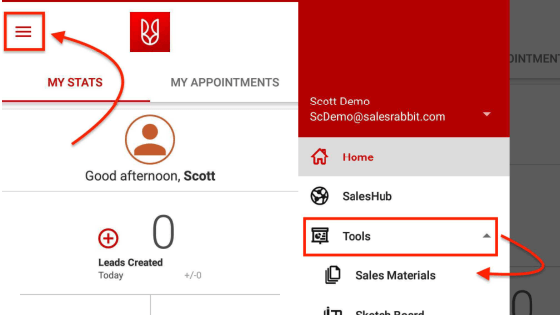
Click on the three horizontal bars in the upper left-hand corner of the screen. 

Step 2.

Inside of the menu bar click on “Tools”, then select “Sales Materials” 

Step 3.

In the “Tools” section make sure it says “Sales Materials” at the top of the screen. To ensure your Sales Materials are up-to-date click the refresh icon (two arrows circling) in the upper right-hand corner of the screen. Then your Sales Material will begin to download to your device.

Viewing Sales Materials in the App (iOS)

This article will outline how to view any uploaded Sales Materials on your iOS device. To view the Sales Materials in the app, they must be downloaded to your device.

Note: ***When you first log into the app or if you have added materials from the last time you updated it will prompt you to update your Sales Materials. If you choose “Update” it will start downloading them immediately. If you choose “Later” then you have to download them manually.***

Step 1. Navigate to More

Click on the three dots in the bottom right-hand corner of the screen.

Step 2. Getting To The Sales Materials

Inside of the “More” menu, click on “Tools”, then select “Sales Materials”

Step 3. Viewing Your Sales Materials

To ensure your Sales Materials are up-to-date click the refresh icon (two arrows circling) in the upper right-hand corner of the screen. Then your Sales Material will begin to download to your device. Click on the folder or item that you would like to view.

Pro Tips:

  • When downloading you can see the progress through the status bar in the middle of the screen. The number in red next to “Tools” icon will also tell you how many materials you have left to download.
  • When you click on a PDF, the file will populate in a file format, ideal for customer viewing. The file can be forwarded or printed using the icons in the upper right hand corner of the app.

Access our Help Center

If you have different questions you need answered, contact our support team at (801) 418-9009 or email them at support@salesrabbit.com for assistance. Or to learn more about what we can do for you and your sales process, schedule a demo for free. If you’re already a SalesRabbit user, login to our Help Center and get unlimited SalesRabbit resources.

21 Motivational Social Accounts to Follow

Zac Kerr

Success can be found in a lot of different places and if you’re in sales, motivation is a vital part of being successful. If you’re lacking daily motivation or you just want to find even more quotes, ideas, or practices to incorporate into your professional and personal life, check out these awesome social media accounts to follow.

21 of the Most Inspiring Social Media Accounts to Follow

Some of these are sales specific accounts that teach you how to be a leader in your field and others simply provide you with motivation and inspiration to live your life to the fullest. These are definitely not all of the motivational social media accounts out there, but these are some of the best that have inspired us as well. Check them out:

  1. @6amsuccess
  2. @MotivationMafia
  3. @scoremoresales
  4. @the.success.club
  5. @addicted2success
  6. @Millionare_Mentor
  7. @simonsinek
  8. @SUCCESS Magazine
  9. @GabbyBernstein
  10. @MindsetofGreatness
  11. @SuccessBlueprint
  12. @MindShiftKQED
  13. @TED
  14. @motivation_mondays
  15. @fiveminutejournal
  16. @entrepreneur
  17. @LoriGreiner
  18. @incmagazine
  19. @bridgegroupinc
  20. @morganjingram
  21. @motoceo

Who Do You Follow?

Any of these accounts on Instagram and Twitter are great ways to get inspired by others that are living the life you want. What are some of your favorite social media accounts to follow for motivation? Comment down below! Or if you feel like we’re missing a great motivational account that you love, let us know in the comments.