SalesRabbit Wins: Top Badges in the Summer 2026 G2 Reports
Shawn Jolley
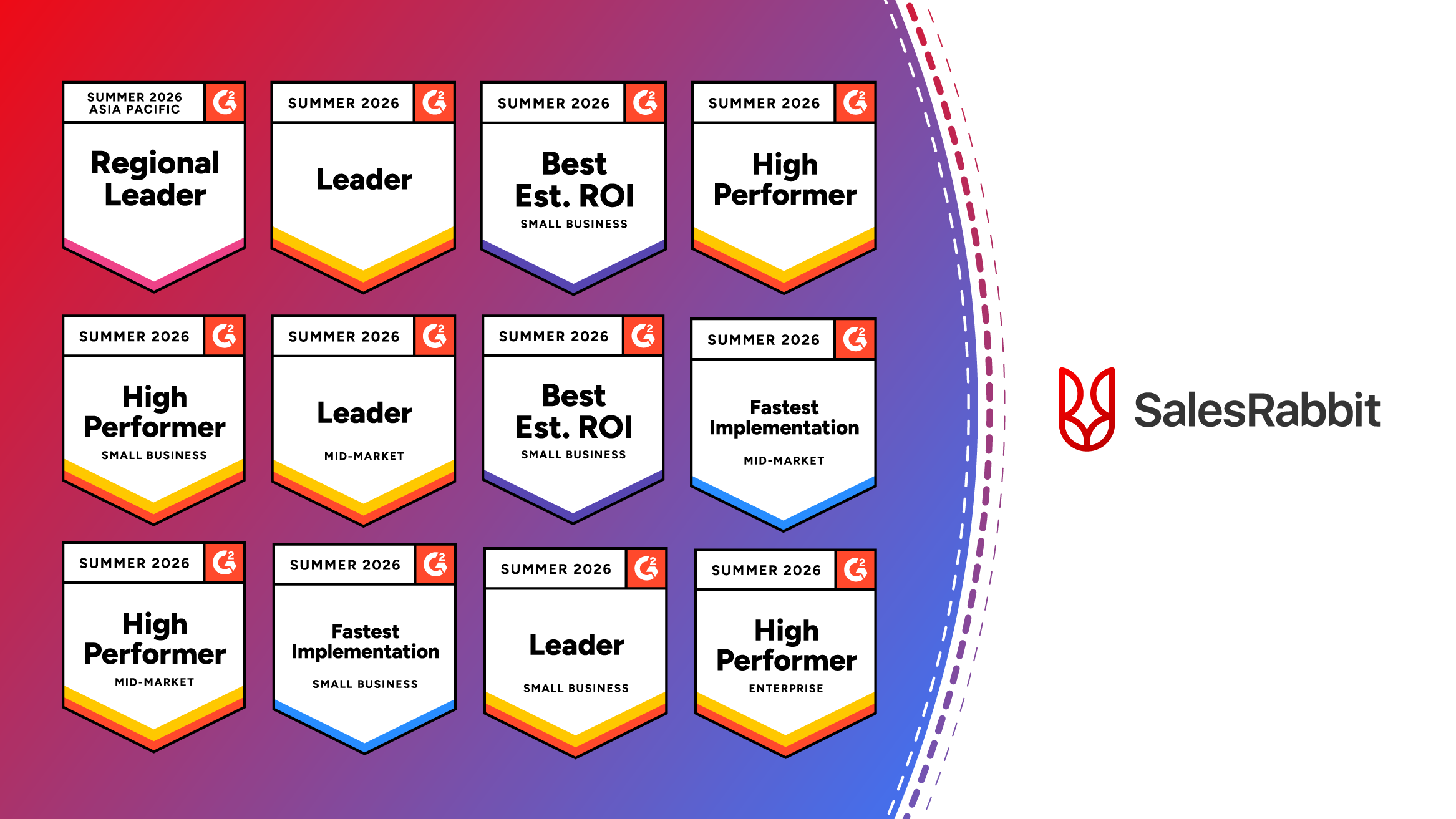
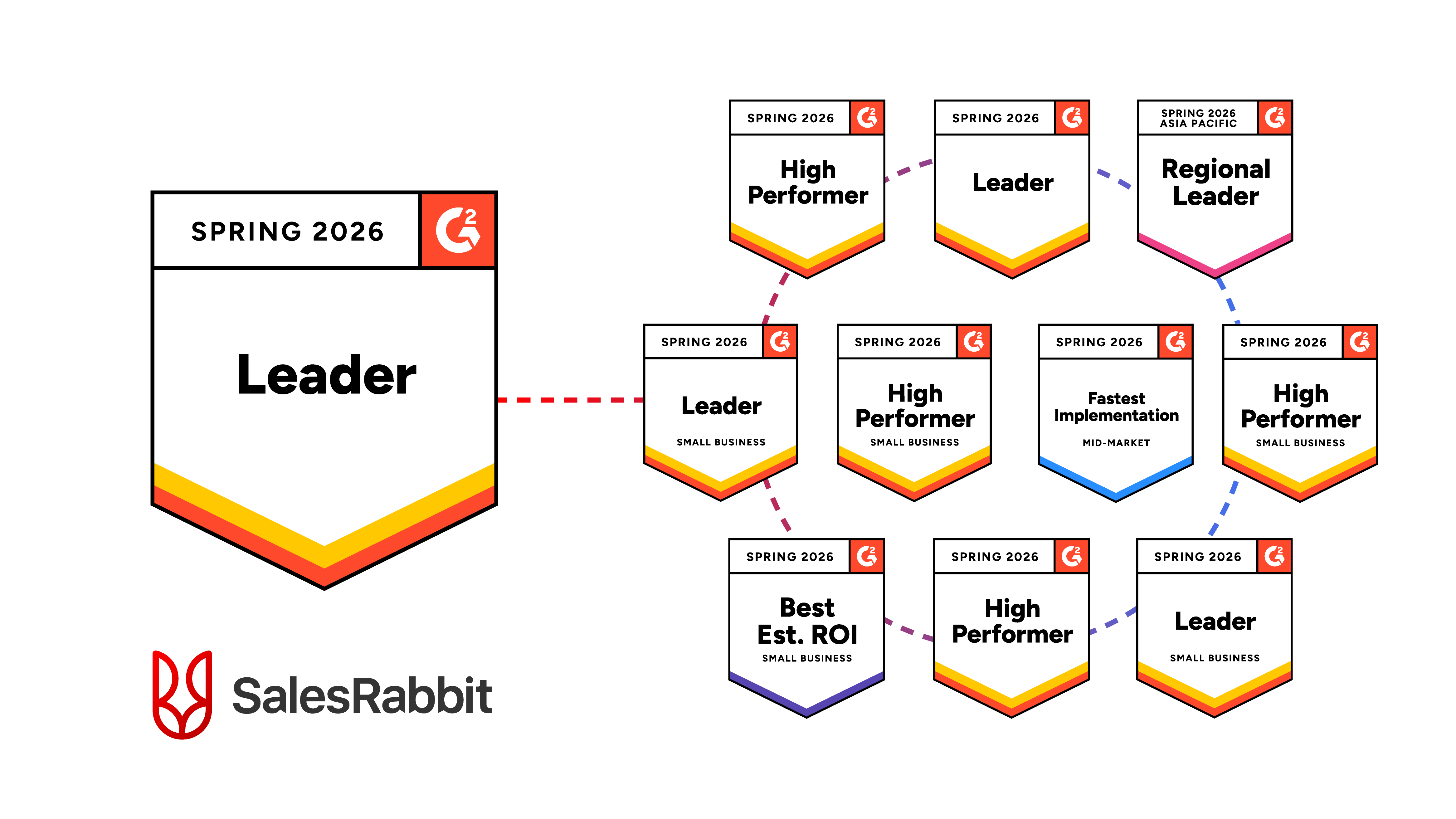
G2 recently released their Summer 2026 software reports. SalesRabbit took home 12 badges across four main areas: Field Sales, Route Planning, Location Intelligence, and Business Intelligence.
For owners running outside sales teams, these categories translate directly to the field. They show that SalesRabbit fixes the daily problems of managing a large group of reps.
The standout move this season: SalesRabbit jumped from #7 to #2 on the Mid-Market Grid Report for Field Sales.
The Field Sales category is about holding the system together. You need a tool that stops leads from falling through the cracks between the first knock and the signed contract. Five Summer 2026 badges across Mid-Market, Enterprise, Small-Business, and Asia Pacific prove SalesRabbit helps teams lock down their entire sales process.
The Route Planning category is about reclaiming hours that reps lose to non-sales drive time. When you can route a team intelligently, the math changes. The Small-Business Implementation Index for Route Planning moved from #12 to #8 quarter-over-quarter, the biggest jump on the board.
The Location Intelligence category is about map control. When you run a big team, you need to know exactly where your reps are knocking and which territories actually produce. Earning badges in Small-Business Results and Mid-Market Implementation means SalesRabbit’s maps deliver in the field, not just in the demo.
The Business Intelligence category is a new addition to the SalesRabbit badge count. This is the executive-command piece — the reporting layer that turns rep activity into the numbers owners use to run the business at a leadership level.
We build software to help owners track their teams, stop losing leads, and close more deals. Twelve G2 badges in one season show that it works.
10 Sales Intelligence Companies Modern Revenue Teams Are Evaluating in 2026
Shawn Jolley
60% of field reps lose one to two hours every day to non-sales work—manual CRM updates, route planning, internal pings, and chasing answers that should already be in the system. That number, pulled from the SalesRabbit 2026 Field Sales Report, is the entire reason the sales intelligence category exists.
The pitch from every sales intelligence company sounds the same: cleaner data, faster prospecting, more pipeline. The reality is messier.
The platform isn’t the differentiator. The data underneath it—and how well it fits your selling motion—is.
About Sales Intelligence Platforms
Sales intelligence platforms cluster into a few honest categories: B2B contact databases, account-based intent platforms, sales engagement layers, and a small group of field-sales tools nobody puts on these lists.
Most buyers shop one tier and ignore the others. That’s where the wrong purchase happens: without proper comparison.
Below is a comparison of the 10 sales intelligence companies actually showing up in 2026 evaluations. For each one, you’ll see what it does well, who it fits, and where the gaps tend to bite.
Table of Contents
How We Picked These 10 Sales Intelligence Companies
Three filters shaped the list:
Currently competing for evaluations. Every platform here is showing up in active 2026 buying cycles, not coasting on legacy brand recognition.
Distinct value prop. No two platforms here solve the same problem the same way. If two vendors do the identical thing, the better-rated one made the cut.
Defensible data or distribution. Either the platform owns its data pipeline, or it owns a position in the buyer’s workflow that’s hard to replicate.
That filter cut several big-name regulars. What’s left is the actual evaluation set that most revenue leaders are working through.
1. ZoomInfo
ZoomInfo is the default enterprise pick for B2B contact and company data. The platform claims roughly 220 million active contacts, including 150 million emails and 50 million phone numbers, with intent signals, website visitor tracking, and digital advertising layered on top.
It’s the platform you buy when budget isn’t the constraint and depth of US contact data is. Implementation takes time, contracts run multi-year, and the learning curve is real.
Best for: Enterprise sales orgs prospecting into mid-market and large accounts in North America.
Where it falls short: International data quality (especially EMEA mobile numbers) lags purpose-built European platforms. The Data Passport add-on is required to unlock global coverage.
Watch out for: Renewal pricing surprises and credit consumption that scales faster than expected.
2. Apollo.io
Apollo.io is the budget-friendly all-in-one. The database covers 265+ million contacts with built-in email sequencing, dialer, and engagement workflows, which is why startups and small teams keep choosing it over heavier platforms.
The trade-off is data quality. Independent comparisons consistently put Apollo’s accuracy in the 65–80% range, which is fine for top-of-funnel volume plays and rough for high-stakes outbound.
Best for: Startups, SMBs, and individual reps who need data and outreach in one tool without an enterprise contract.
Where it falls short: Phone number accuracy and the dual-credit system (charged once for email, again for mobile) make it a poor fit for dial-heavy teams.
Watch out for: Treating it like a full sales intelligence platform when it’s really a prospecting workspace stitched on top of a contact database.
3. Cognism
Cognism is the sales intelligence platform purpose-built for EMEA-focused teams. The company’s verified mobile data (“Diamond Data”) and multi-step compliance validation make it the default pick for organizations selling into Europe under GDPR.
It’s increasingly competitive in North America, but EMEA coverage is the original moat. Pricing is gated and tilts mid-market and up.
Best for: Mid-market and enterprise teams with EMEA pipeline targets, or any global org where compliance is a board-level concern.
Where it falls short: US-only teams may find pricing harder to justify versus North America–native platforms.
Watch out for: Sales teams that don’t actually need international data buying the broader package and underusing it.
4. LinkedIn Sales Navigator
LinkedIn Sales Navigator is the ground truth for who works where. No other platform has LinkedIn’s freshness on job changes, role transitions, and team structure, because the data comes straight from the people themselves.
What it doesn’t have is contact data. You can find the right buyer in seconds and still not have an email or phone number to reach them, which is why most teams pair Sales Nav with a contact data provider like Cognism, ZoomInfo, or Apollo.
Best for: Every B2B sales team. It’s table stakes more than a differentiator.
Where it falls short: No native contact data. CRM sync and reporting are gated to the higher-tier plans.
Watch out for: Treating Sales Nav alone as a complete sales intelligence stack. It’s the search layer, not the data layer.
5. 6sense
6sense is the leader in account-based orchestration. The platform combines intent data, predictive analytics, and AI-driven account scoring to tell you which accounts are actually in-market, not just which ones look like good ICP fits.
It’s a marketing-led purchase that bleeds into sales. Pricing starts in the $50K+ range and climbs from there.
Best for: ABM-driven enterprise teams where marketing and sales share an account-tier model.
Where it falls short: Overkill for high-velocity SMB sales motions. The setup investment is significant.
Watch out for: Buying it before the account model and territory carving are mature. The data won’t fix a fuzzy GTM.
6. Demandbase
Demandbase sits in the same enterprise ABM tier as 6sense. The platform’s account identification, advertising, and sales intelligence modules are typically bought separately, which is both a feature and a budget trap.
The big strength is unifying advertising, web personalization, and sales handoffs around the same account model. The cost of unifying everything is six-figure annual spend and a meaningful implementation lift.
Best for: Enterprise teams running coordinated ABM campaigns across paid media, web, and sales.
Where it falls short: Mid-market teams often outgrow the entry tier before they grow into the enterprise tier; pricing has a real gap in between.
Watch out for: Buying the sales intelligence module without the orchestration layer and missing most of the platform’s value.
7. Bombora
Bombora doesn’t sell contacts; it sells signal. The platform’s Company Surge methodology aggregates content consumption across a cooperative of 5,000+ B2B publishers to flag which companies are quietly researching specific topics.
That signal is what most other sales intelligence companies wrap and resell. Buying directly from Bombora makes sense when you have the data infrastructure to act on raw intent.
Best for: Marketing ops and revenue teams with a mature data stack that can route intent into outbound and ads.
Where it falls short: Without strong activation infrastructure, raw intent data sits in a dashboard and decays.
Watch out for: Confusing topic-level intent with buyer-level intent. Bombora flags the company; your team still has to find the human.
8. Lusha
Lusha is the speed-to-contact pick. The Chrome extension surfaces direct dials and email addresses on LinkedIn profiles in a click, which is why individual reps and small teams default to it.
Where it gets thin is at scale. Credit-based pricing punishes heavy dialers, and the database depth doesn’t compete with ZoomInfo or Cognism on enterprise contact research.
Best for: Individual reps and small teams that want fast, transactional contact lookups without a long sales cycle to buy the tool.
Where it falls short: Total addressable contact volume and intent signal depth are limited compared to enterprise-tier platforms.
Watch out for: Scaling Lusha to a 50-rep org and quietly paying enterprise prices without enterprise capability.
9. Seamless.AI
Seamless.AI markets itself on real-time AI search for contact data. The platform builds prospect lists on demand and includes pitch intelligence and sales script writing as add-ons.
The accuracy story is mixed. An independent comparison of Apollo and ZoomInfo competitors flagged Seamless for high bounce rates even on data marked as high confidence.
Best for: Teams that want pay-as-you-go contact data and don’t need integrated engagement workflows.
Where it falls short: Data quality consistency. Bounce rates and missing company fields create downstream cleanup work.
Watch out for: The credit math. Real usage tends to outpace what the entry plan implies.
10. Breeze Intelligence (formerly Clearbit)
Breeze Intelligence is HubSpot’s rebrand of Clearbit, focused on enriching website visitors, form submissions, and CRM records in real time. The play makes most sense inside a HubSpot stack, where the integration depth is what you’re really buying.
For non-HubSpot shops, the value is harder to underwrite. Standalone Clearbit was already heavily marketing-led; the HubSpot integration tilts that further.
Best for: Marketing-led mid-market teams already standardized on HubSpot.
Where it falls short: Outbound sales teams without HubSpot will get more from a contact-first platform.
Watch out for: Buying it for sales intelligence and using only the form-shortening feature.
What Sales Intelligence Lists Always Miss
Every sales intelligence comparison treats sales as one motion: B2B sales reps prospecting B2B buyers from behind a desk. That’s accurate for SaaS and not much else.
22% of sales leaders cite aggressive competition as the top threat heading into 2026, per the SalesRabbit 2026 Field Sales Report. Field sales orgs feel that pressure differently than inside teams.
The intelligence problem for field teams isn’t “find me a verified mobile number.” It’s “tell my reps which streets in this neighborhood are worth knocking, and which ones to skip.”
That’s a different stack. AI-powered territory management, predictive household scoring, weather and storm overlays, route optimization, and rep-activity visibility don’t show up in B2B contact databases for a reason: they live one layer up.
63% of sales teams report no AI adoption or are still researching tools, per the same report. For field sales orgs especially, the gap isn’t always a contact data gap; it’s a territory and execution gap that no ZoomInfo subscription can close.
The right sales intelligence company for your team is the one whose data matches the way your reps actually sell. If your motion is door-to-door, in-home, or any field-based pipeline, see how SalesRabbit gives field teams the intelligence layer B2B platforms don’t and stops the “where do I knock next” question from costing reps hours per day.
Playing Favorites is Killing Your Culture: How to Schedule Leads Fairly
Ben Nettesheim
It is Friday morning. The manager stands in front of the room, manually assigning fresh appointments from a printed list. They hand three premium leads in a gated neighborhood to the veteran who always hits quota. They give two tough doors on the edge of town to the rookies.
The manager is not playing favorites. They are just trying to distribute the board quickly and get people out the door. But the rookies think the game is rigged. The whispers start before the meeting even ends.
The bullpen culture begins to rot. Manual lead assignment generates doubt, and doubt makes top performers quit. To protect your culture, you have to take the manual element out of the process, which is one of the core pillars supporting Advanced Appointment Management.
The Psychology of the Bullpen
Nothing destroys a sales floor faster than suspicion that opportunity is being hoarded. Sales is a highly competitive environment. Reps need to believe that the system rewards hard work and skill, not personal relationships with management.
When managers assign appointments manually on the fly, honest mistakes happen. Biases creep in. The perception of unfairness is just as damaging as actual unfairness. Resentment builds. The bullpen gets toxic. Before long, your best people start looking for an exit because they feel the system works against them.
Replacing a top producer costs an organization massive amounts of time and capital. Protecting the culture is important to the bottom line.
The Burden on Regional Managers
The pressure of making subjective assignment choices every day exhausts managers. They spend hours staring at spreadsheets, trying to balance the needs of the veterans with the development of the rookies.
Every routing decision becomes a potential argument. A manager should be coaching their team on how to close deals, not defending why a specific lead went to a specific rep. The manual process creates unnecessary friction and wastes valuable leadership bandwidth.
Replacing Bias
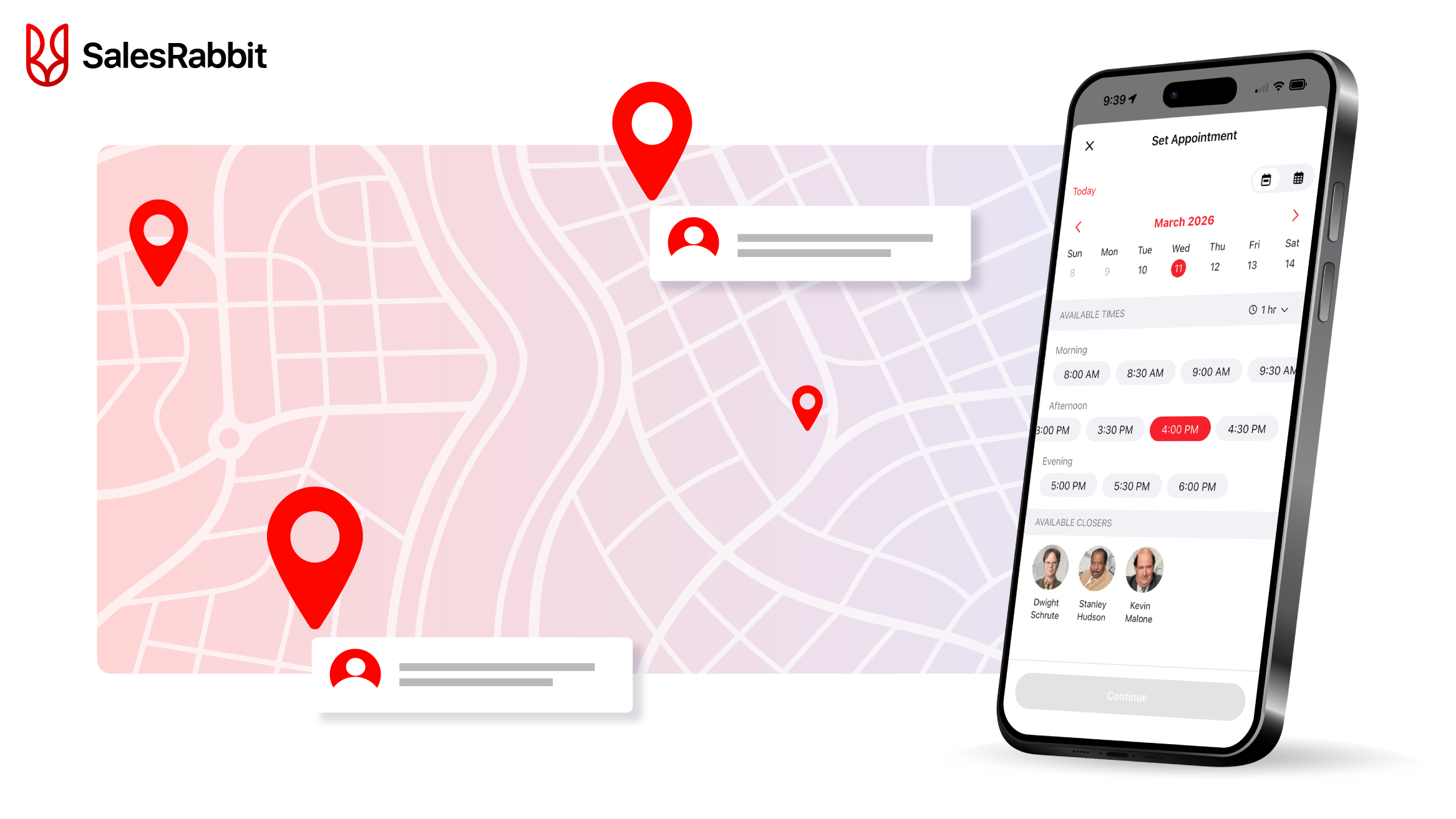
Technology acts as the ultimate liability shield. Advanced Appointment Management gives you a way to distribute opportunities without policing fairness.
Letting Math Distribute the Leads
When a new appointment comes in, the system automatically routes the new lead to the correct rep. The math is absolute. The drama disappears because the reps know the distribution is fair.
Locking Down the Board
A fair system only works if reps cannot manipulate it. Managers lock down the routing rules so no one can manually jump the line or steal a premium lead. Leadership decides exactly who is allowed to set appointments and who can receive them. This keeps the workspace tightly controlled while the software handles the heavy lifting.
Automation kills the drama. Reps stay hungry because they know the distribution is fair. Managers get their time back and never have to defend a routing decision again.
Stop Letting Scheduled Deals Die: The Cost of a Duct-Taped Calendar
Shawn Jolley
A top producer finishes a morning pitch, checks their phone, and sees a one o’clock appointment across town. They fight forty-five minutes of traffic only to arrive at an empty driveway. The homeowner canceled two hours ago. The office updated a master spreadsheet, but that spreadsheet does not talk to the rep’s personal calendar.
The rep just lost two hours of prime selling time.
This is not a rounding error. It is a massive revenue leak. Field sales teams are bleeding capital simply because their scheduling systems lack basic visibility: a blind spot you can fix with Advanced Appointment Management.
What’s Causing the Revenue Leak?
Windshield time is often written off as a cost of doing business. The data tells a different story.
According to the 2026 Field Sales Report, 71% of reps lose one to two hours every single day to inefficiencies.
Consider the scale of that leak. If you have a team of fifty reps, more than two-thirds of them losing two hours a day equals five hundred wasted hours every week. That is the equivalent of more than a dozen full-time employees doing nothing ROI-related. A duct-taped scheduling process costs you thousands in lost revenue and rapidly burns out your most talented performers.
The Manager Can’t Fix What They Can’t See
Regional managers cannot fix routing inefficiencies if they cannot see the board.
When a cancellation happens, the manager needs to know immediately so they can salvage the lost hour. If a rep has two appointments on opposite sides of the city, the manager needs the ability to spot the error and adjust the schedule before the rep turns the key in their ignition. Relying on phone calls and text updates leaves the manager blind to the reality of the field.
A Centralized Schedule Fixes Visibility
Centralized scheduling reclaims lost hours and turns them back into selling time. Advanced Appointment Management provides the visibility required to run a tight, profitable organization.
You Can See the Whole Board
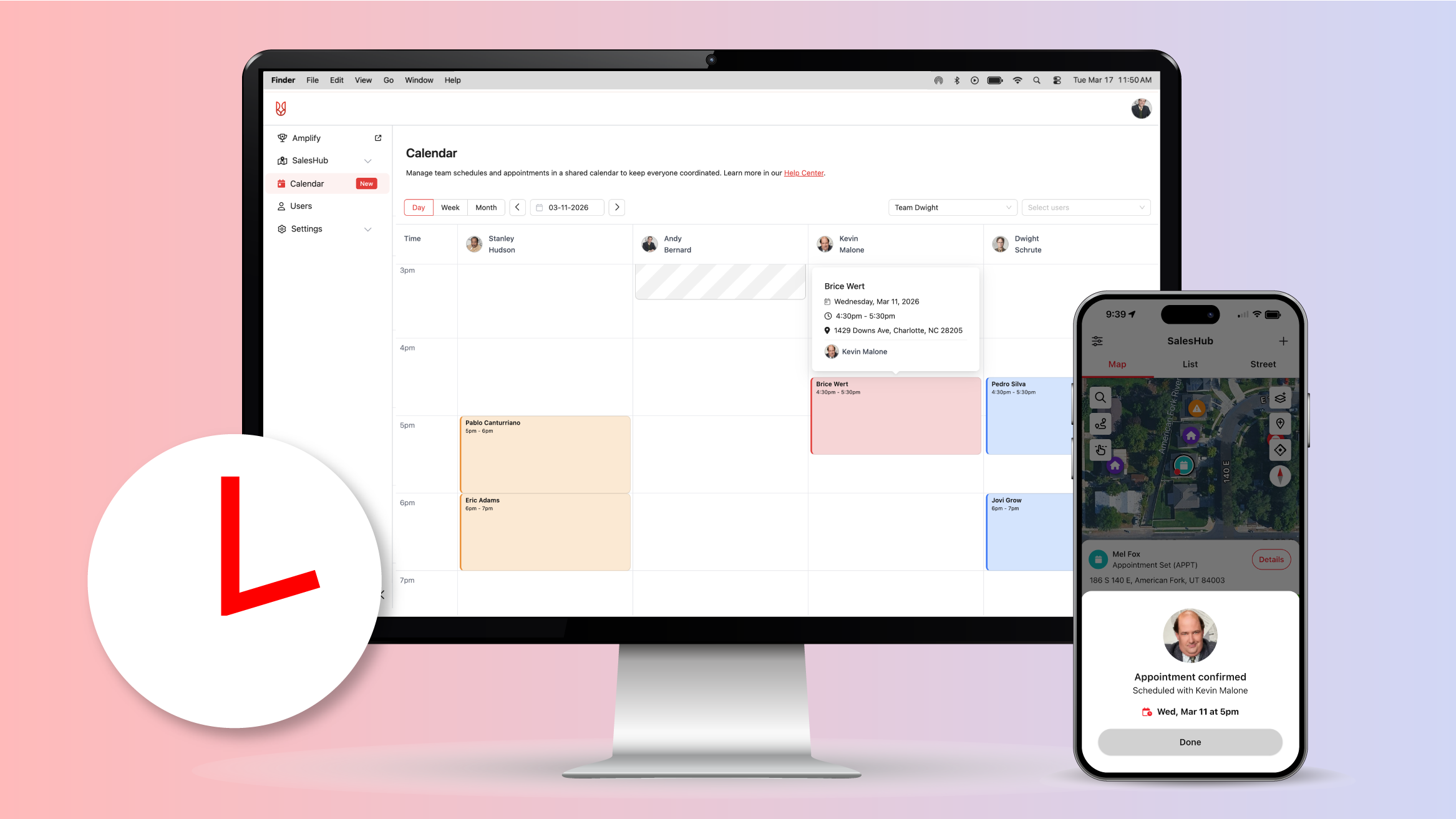
Managers gain a dedicated, bird’s-eye view of the entire operation on both their phone and their computer. If a cancellation happens, they see it in real time. They can instantly grab a different rep who is only five minutes away and reroute them, saving the appointment and the gas money.
You Can Stop the Double-Books
To keep the schedule airtight, reps seamlessly sync their preferred personal calendars directly to the platform. The system always knows exactly who is available without anyone having to ask. It prevents overlapping appointments and eliminates the need to chase down reps for their schedules.
You Can Fence Off the Schedule
Burnout is a real threat in field sales. Managers can lock in specific working days and hours for the team. The schedule is fenced off, so reps are never accidentally booked on their days off, protecting their personal time and keeping them sharp for their actual shifts.
Fix the calendar and put your reps back on the doors.
The Appointment is Broken: Why Your Setter-to-Closer Handoff is Bleeding Deals
Brent Bird
A setter grinds through a ninety-degree afternoon and finally pulls a yes out of a skeptical homeowner. He grabs his phone and drops the address and time into a chaotic company group text. The closer shows up the next day at the wrong time. The homeowner is already annoyed.
The deal dies on the porch. The setter loses a commission. The closer loses trust in the team.
Relying on group texts, manual data entry, and clunky calendars means high-intent leads slip through the cracks—a problem Advanced Appointment Management was built to eliminate.
The Cultural Cost of Bad Logistics
Field sales runs on momentum. When a setter successfully opens a door, they expect the organization to support that win. Dropping that lead into a disjointed scheduling process breaks the chain of trust.
Setters stop believing their hard work will result in closed deals. Closers begin to resent the setters for providing inaccurate information or double-booked time slots. The friction quickly turns into a management nightmare, forcing regional leaders to spend their days mediating disputes between reps instead of driving revenue.
Beyond the internal culture, a botched handoff damages the brand. A homeowner who experiences scheduling problems before the pitch even happens is unlikely to sign a contract.
Why Group Texts and Spreadsheets Fail
Most sales organizations duct-tape their process together. They use a CRM for lead tracking, a group text for communication, and an unsynced, third-party app for calendar management.
These systems do not talk to each other naturally. Every time data moves from one platform to another, a human being has to type it out. Human beings make mistakes. They mix up numbers. They forget to update the master spreadsheet. They fail to check for overlapping appointments. The result is a broken handshake between the setter and the closer.
The Anatomy of a Perfect Handoff
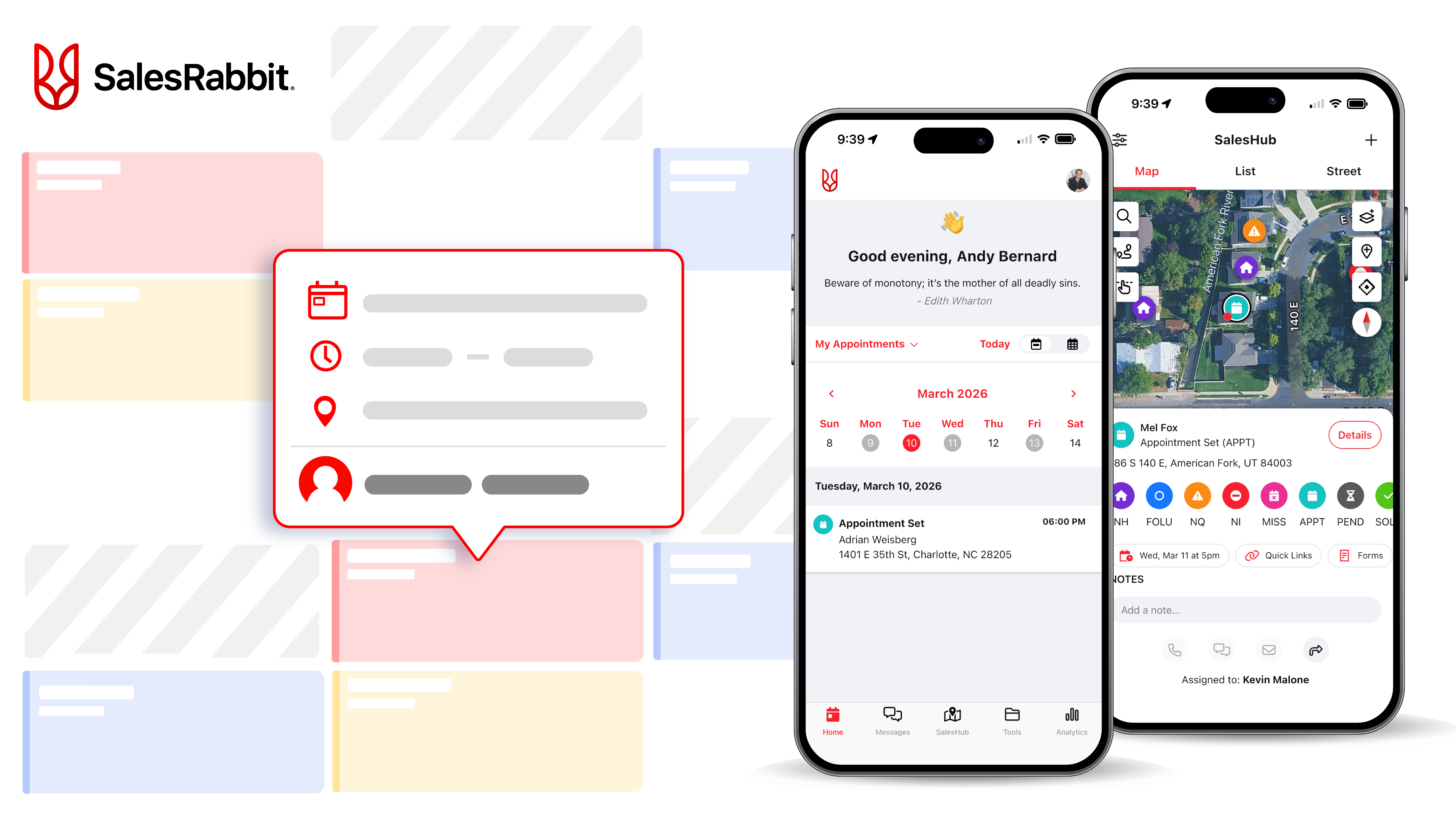
Advanced Appointment Management physically changes this workflow. The software syncs third-party calendars seamlessly and brings the scheduling process inside the platform. It turns a clumsy, trust-breaking handoff into an automated baton pass.
Forcing the Notes Before the Booking
The handoff process starts at the door. Setters need to pass along vital context without breaking their workflow. Instead of hoping they remember to text the details later, the system physically requires them to log the homeowner’s specific objections, the current state of their roof, or the best place to park before it allows the appointment to be booked. The closer arrives fully prepared to sell.
Syncing the Actual Calendars
Accidental double-booking is the fastest way to burn a lead. The fix is simple: connect the scheduling tool directly to your reps’ actual Google or Outlook calendars. The setter only sees the closer’s real-time availability. When properly set up, booking two appointments for the same hour becomes technically impossible because of 2-way sync.
Controlling the Routing Path
Every sales team operates differently. Managers need total control over how a lead moves from the front line to the closer. You can configure the workflow to allow setters to hand-pick a specific closer they trust, or you can mandate an automated distribution system to keep the workload even across the board.
Killing the Manual Pipeline Updates
Manual pipeline updates drag down efficiency. Software should do the heavy lifting. The second the appointment is booked on the calendar, the lead status automatically flips to “Appointment Set.” Manual data entry isn’t required between steps, ensuring the pipeline is up to date.
Capital in the Ground, Reps on the Street: Why Telco Runs on SalesRabbit
aurash takmili
Telco providers are burying billions of dollars in fiber-optic cable and new wireless infrastructure. Capital is flowing directly into the ground. Engineering teams fight for municipal permits, coordinate heavy machinery, and lay miles of physical network. They light up the grid.
Then the real problem starts.
The Metric That Matters: Take Rate
The financial survival of these engineering projects comes down to one number: the take rate. This is the percentage of homes in a newly upgraded footprint that actually buy the service. If the take rate stays low, the entire infrastructure investment fails. You can build the fastest network in the state, but it means nothing if the legacy cable company keeps all the customers.
Digital marketing hits a wall in saturated markets. When an incumbent provider and a new fiber company fight over the same zip code, online ads blur together. Direct mailers go straight into the trash. Homeowners ignore generic emails about gigabit speeds.
To win the neighborhood, telco providers have to put trained representatives directly on the doorstep. Physical presence moves a conversation. A rep standing on a porch can point to the newly trenched yard, explain exactly why the homeowner’s current internet buffers at night, and sell the upgrade.
But just sending teams into the field without the proper tools creates a massive blind spot. Telco executives need total command over their field operations. You cannot run a modern sales organization on assumptions. You need a bridge between the sidewalk and the corporate office.
Why the Large CRM by Itself Fails in the Field
A telco firm runs on heavy software. You have massive databases, network provisioning tools, and complex billing systems. Platforms like Salesforce and HubSpot are great systems of record. But they belong on desktop computers inside an air-conditioned office.
Enterprise CRMs fail on the sidewalk. They lack the geospatial interfaces and rapid mobile workflows a canvasser needs while walking down a street. Field reps require software they can operate with one hand in the sun.
When you force a field team to use office software, administrative drag spikes. Representatives end up sitting in parked trucks doing manual data entry instead of knocking on doors. Managers sitting in corporate offices cannot see where their reps are or if they are actually working.
Visibility equals revenue. If you cannot see the field activity, you cannot scale it. Telco companies use SalesRabbit as the specialized front-end application for the physical world. It fixes the visibility gap and pipes structured data directly back into your main CRM.
Security and Professionalism on the Doorstep
For a large telco, protecting customer information is a massive hurdle that many systems fail to address. Carrying around paper clipboards with names, addresses, and phone numbers is a severe liability.
Digitizing the process secures the data entirely within the application. It also changes the dynamic at the door. When a representative shows up with a structured digital interface instead of a piece of paper and a pencil, it projects immediate professionalism. They know exactly who they are talking to, and the homeowner feels a distinct sense of security.
Eradicating Wasted Payroll with Targeted Data
Telco organizations buy field sales software for one reason: to increase closed contracts per rep.
The old approach to telco sales was blind canvassing. Representatives knocked on every single door within a boundary, ignoring whether the person inside could actually buy. This wastes massive amounts of payroll. Paying a representative to pitch a renter who has no authority to authorize a fiber installation is throwing money away.
Data beats hustle. SalesRabbit fixes this through DataGrid AI.
The software analyzes consumer, property, and demographic data for every address in a market. It assigns a Buyer Score to individual homes by looking at variables like homeownership status and property value.
Telco teams use this scoring to target the exact prospects who are statistically likely to buy. Moving from blind canvassing to data-driven territory ownership lowers your Customer Acquisition Cost.
It also profoundly changes the psychology of the field rep. When you put a high-probability lead directly into the hands of the right person, they have a legitimate chance to close it. The reps actually feel better. They stop knocking on doors expecting no one to answer and start approaching houses knowing a buyer lives inside.
Protecting Pipeline in Network Dead Zones
Telco reps work on the edge of the network. They walk through newly constructed housing developments and rural peripheries where cell service is unstable or missing entirely.
Most field software relies on constant cloud connections to load maps and save data. When a rep hits a dead zone, the map goes blank and the lead data disappears. A dropped map means a lost lead, and a lost lead means a leaked pipeline.
SalesRabbit solves this with localized device caching. Reps keep charting leads, logging notes, and working territories without an active internet connection. When the rep drives back into cell service, the device automatically syncs with the central server. For a telco firm operating on the edge of infrastructure, offline reliability is mandatory.
Controlling Multi-Dwelling Unit Chaos
Multi-dwelling units are incredibly lucrative. Wiring a single building containing hundreds of potential subscribers maximizes your infrastructure return. But canvassing these structures is a logistical nightmare. Tracking physical access and systematic progress door-by-door is difficult.
SalesRabbit lets organizations upload exact multi-family building lists into the mapping interface. Canvassing teams track exactly which apartment units have been contacted, which residents signed contracts, and which doors have strict no-soliciting rules. Legacy CRMs cannot visualize this granular tracking inside vertical structures.
We also track the real estate market. When someone buys a new home, they need internet immediately. Engaging these buyers before they default to the incumbent provider is a massive priority.
The Movers add-on automatically maps new homeowner leads. It plots recent property transactions visually on the representative’s map. Fiber reps use this data to intercept new residents at the exact moment their purchasing intent is highest.
Zero-Touch Provisioning Directly from the Doorstep
Closing a telco contract used to be an administrative mess. Reps carried paper, chased pen-and-paper signatures, and handed documents to a back office for manual entry. That delay between the verbal “yes” and the actual internet installation kills deals.
You stop pipeline leakage by standardizing how leads move from the door to the close.
SalesRabbit removes the friction with a digital contract. You digitize your service agreements, equipment leases, and credit check authorizations. Representatives get the signature on the glass and close the deal instantly in the field.
The Operational Power of the Digital Lead Card
Field managers often cite the digital notes and lead card functionality as the biggest operational shift for their teams. Before a rep even walks up to the address, they can pull up the lead card and review specific scripts, reminder points, and historical notes. They know exactly what they need to talk about before the door opens. For new agents, this provides an immediate safety net of reference material right in their hands.
A field sales platform only works if it talks to your other software. SalesRabbit connects directly to your enterprise architecture through an open API and an integration marketplace. When a rep marks a lead as closed, that data syncs instantly with Salesforce. You eliminate dual entry.
Through custom API endpoints, you can trigger a specific workflow the second a contract is signed. The app tells your billing software to create an account, tells the dispatch module to schedule the installation, and tells the warehouse to grab a router. You navigate the entire process with basically zero human administrative work in the back office.
Stopping Burnout Before It Starts
Door-to-door sales will burn your reps out. Geographic isolation and constant rejection break people down. When motivation drops, activity drops. When activity drops, your infrastructure return is delayed.
Turnover is expensive. Professionalizing the reps prevents burnout.
SalesRabbit helps maintain your sales culture. The app logs every knock and closed contract instantly, feeding that data into leaderboards.
You unlock the competitive instincts of your salesforce. Reps open their phones and see exactly how they rank against their peers. The software is a high-performance tool that increases their commission checks.
Executive Command Over Network Expansion
The data your reps gather on the street dictates where you build next.
If a newly launched fiber network sees a sudden drop in conversion rates, management can check the field data to find out why. If reps start logging a competitor’s new promotional offer, the provider can execute a retaliatory pricing response quickly.
The field data also tells your engineers where to dig. Representatives constantly talk to homeowners who live just outside your current service area. When they log those highly interested prospects, your organization builds a localized data map of potential future revenue.
Network engineers and executives can incorporate that data to decide where to trench the next line of fiber and build the next node.
The choice to use specialized spatial canvassing software represents organizational maturity. Companies that bridge the gap between generalized corporate CRMs and specialized field architecture gain a decisive advantage over their competitors.
✅ To explore how these capabilities map to your operation, book a demo.
SalesRabbit Wins: Top Badges in Spring 2026 G2 Reports
Brent Bird
G2 recently released their Spring 2026 software reports. SalesRabbit took home 11 badges across three main areas: Field Sales, Location Intelligence, and Sales Performance.
For owners running outside sales teams, these categories translate directly to the field. They show that SalesRabbit fixes the daily problems of managing a large group of reps. You move away from guessing and start running your business on actual numbers.
The Location Intelligence category is about map control. When you run a big team, you need to know exactly where your reps are knocking. Earning this badge means our maps help you see your whole market. You stop wasting time and ensure your team never misses a good door.
The Field Sales category is about holding people accountable. You need a system that stops leads from falling through the cracks between the first knock and the signed contract. Placing well here proves SalesRabbit helps teams lock down their entire sales process, so no deal gets lost.
The Sales Performance category comes down to reporting. You cannot grow a business if you do not know which reps are actually producing. This recognition highlights our tracking tools. They give owners a clear look at who is closing deals.
We build software to help owners track their teams, stop losing leads, and close more deals. The G2 badges show that it works.
Want to see how real companies use SalesRabbit to grow?
Building out a new telco market is a race. You have fiber in the ground, the hardware is ready, and the board wants to see a return immediately. The old way to win was simple: hire 50 more reps, give them a zip code, and tell them to knock until their knuckles bleed.
But that volume-heavy model is failing. Our 2026 Field Sales Report shows that while teams are getting bigger, they are actually getting slower. We call it the efficiency paradox: sales leaders are hiring more people but getting less out of them because the process is cluttered.
We’ve highlighted the five trends that will decide which telcos win their markets this year:
1. The 400-Hour Admin Tax
The data shows 71% of enterprise reps lose two or more hours every day to tasks that have nothing to do with selling. For a team of 50, that’s 400 hours of lost selling time every week.
This admin tax is a primary reason fiber rollouts miss their ROI targets. When you look at where that time goes, 49% is eaten up by manual data entry, and 39% is wasted on travel or trying to figure out where to go next. This isn’t just a minor technical glitch; it means your most expensive talent is not actually selling.
While your reps are in their trucks doing paperwork, a leaner competitor that has automated the drudgery is already knocking on the next door. To get that time back, you have to find every spot in the workflow where a rep stops to complete a task that could be automated.
2. Replacing Guesswork with AI Territory Management
Even though it’s 2026, most enterprise teams are still managing territory based on general maps and best guesses. Only 28% of teams are actually using predictive analytics to decide where to send their reps. Likely because they don’t have sales technology with predictive capabilities.
The traditional method is a blind rollout. A manager highlights a zip code on a map and tells the team to hit every door. This forces reps to engage with homeowners who just signed a contract with a competitor last month or renters who aren’t even qualified to buy. Our report found that 18% of managers feel completely overwhelmed by the manual effort it takes to plan routes. This lack of automation and clear direction burns through your payroll and kills the team’s motivation.
Data-driven territory management flips this. Instead of knocking on every door, your reps only go to the houses that actually have a high chance of buying. You stop sending people out to walk and knock, and start sending them to close.
Being able to predict real buyers and intent before reps knock is your biggest lever for success.
3. The Digital-Physical Handshake
Over a third of field reps (34%) say that unanswered doors are their biggest hurdle right now. The reality is that homeowners don’t trust strangers on their porch. When a rep walks up the driveway, they trigger a smart doorbell notification, and the homeowner just ignores the chime.
To fix this, you have to warm up the porch before the rep ever gets there. Telco teams need to merge their digital marketing with their field sales. This means giving your reps digital air cover by running targeted ads in the exact neighborhoods they are working.
If a homeowner sees your brand on their phone on Tuesday, they are much more likely to open the door when your rep shows up on Thursday. When you establish that familiarity early, you stop being a stranger and start being a solution they recognize. It can shorten the sales cycle and make the “yes” much easier to get.
4. Professionalizing the Rep Experience
Burnout and poor work-life balance—not compensation—drive 28% of attrition in field sales. In an industry where the cost of finding and training new talent is skyrocketing, you can’t afford to lose your best producers because the job is a grind.
Keeping your people means making the job less frustrating. Right now, there is a massive ramp-up gap in the industry: 71% of enterprise managers think a new rep is ready to go in three months, but only 41% of reps feel that way. That gap creates a huge amount of stress. Teams that focus on structured onboarding and weekly coaching improve their retention by 30%. This type of coaching can’t be fully automated and doesn’t belong in the lost time highlighted above.
Professionalizing the job also means using technology to make it easier to win. Whether it’s using gamification (which 53% of enterprise teams are now doing) or simply cutting out the admin work, you have to make the rep’s life better. When commission checks are high and the daily headache is low, your top producers stay. And keeping them is always cheaper than hiring their replacements.
5. Moving from Gut Feelings to Data-Driven Coaching
Nearly 40% of teams have no formal coaching process. In many telco organizations, “coaching” is just a manager telling a rep in a slump to hustle harder.
Telling someone to work harder isn’t a strategy; it’s a way to burn them out. When a rep is struggling, you shouldn’t have to guess why. You should be able to look at the numbers and see exactly where the deal is dying. The best managers use dashboard metrics to see if the problem is the connection rate (getting to the door), the presentation rate (the pitch), or the close rate (getting the signature).
This is what we call Executive Command. It’s the ability to look at the data and give a rep specific, actionable advice that actually changes their numbers. When you replace “hustle harder” with “fix this specific part of your pitch,” you stop losing reps and start hitting your revenue targets.
Data that Tells a Story: Replacing Intuition with Intelligence
The 2026 data shows that the “just work harder” era of field sales is over. In a rollout where every day counts, you can’t afford to have your best reps stuck in their trucks doing paperwork. You also can’t afford to let them wander down streets where nobody is buying.
Winning this year isn’t about having the most people on the pavement. (Volume is only part of the equation.) It’s about having the most intelligence behind every knock. Telco leaders who move from guesswork to precision will be the ones who actually hit their revenue targets and keep their best reps.
Imagine finding an extra ten hours in your week. You didn’t get a promotion. You didn’t get an assistant. You just stopped fighting your own map. And you used data to do it.
In field sales, we talk a lot about the grind. We respect the grit it takes to knock on a door after ten straight rejections. But there’s a massive gap between the grind of a sale and the friction of bad logistics. Busting your tail at a door is the job. Wasting your time on mindless travel is just a waste of your life.
For anyone in the field, time is the only thing that actually matters. When that time is burned on inefficient routes or “spray and pray” canvassing, you aren’t just losing commission. You’re losing your sanity.
Are You Dealing with Invisible Paycuts?
When a rep spends ten hours a week staring at a windshield or zigzagging across a disorganized zip code, they’re taking an invisible paycut. They might as well be working a part-time, unpaid job as a logistics coordinator.
Owners often see this as operational waste. For the rep, it’s a violation of a human boundary. Every hour spent stuck in a truck is an hour that could’ve been spent at the gym, with their kids, or just getting some sleep.
High performers don’t usually quit because they hate selling. They quit because the friction eventually outweighs the rewards. If your territory strategy is “just go find ’em,” you’re asking your team to carry the mental load of your company’s lack of data.
“Sales burnout isn’t just about the hours worked; it’s about the hours wasted on things that don’t result in a win.” –Jill Konrath, sales strategist and author of More Sales, Less Time
True Hustle vs. Mindless Friction
We need to become more aware of this stubborn idea in some sales cultures that if you aren’t exhausted by 8:00 PM, you didn’t work hard enough. That mindset confuses activity with achievement.
The goal of territory intelligence isn’t to make the job easy—it will never be easy. The goal is to make sure that every ounce of hustle you bring to the pavement is spent on a high-probability interaction.
When you remove the friction of bad data and messy routing, you aren’t just increasing the door count. You’re protecting the person knocking them. A rep who finishes their day feeling effective is a rep who shows up again on Monday. A rep who finishes their day feeling like they fought a losing battle against a map is a rep who is already looking for the exit.
Retention is a Choice. You Just Need Data
At SalesRabbit, we believe a higher retention rate is an operational choice. Most field sales teams look at their commission structures when turnover rises, but they should be leveraging their data to optimize territory management and organize route planning. Time saved per rep is a great metric for increasing retention.
If your process steals time from your people, no amount of motivation or energy will keep them. True leadership in the field means providing tools that treat a rep’s time like the limited asset it is. When you optimize a territory, you aren’t just scaling a business; you’re giving your people their lives back. Learn more about using data for territory management.
We surveyed 400 field sales professionals, from canvassers to executives, to build a comprehensive benchmark for the year ahead.
The data reveals a costly disconnect between capital invested and actual time spent selling. Instead of increasing face time with homeowners, broken field processes cost teams hours.
The data shows that 60% of reps spend at least one to two hours daily on non-sales tasks.
Numbers also reveal that 45% of organizations still rely entirely on manual territory assignment.
The top 3 workflow drains are:
Manual CRM updates
Inefficient travel
Internal meetings
At its core, the 2026 Field Sales Report breaks down the specific challenges facing the industry and how teams use real-time data to fix them.
One takeaway: the teams pulling ahead are automating data capture and territory management.

 Shawn Jolley


 Ben Nettesheim




 Brent Bird



 aurash takmili









You must be logged in to post a comment.