
 Ben Alves
One veteran roofing owner told us he figured he’d heard it all and had mostly stopped going to events like this one. He told us he was glad he came to Rabbit Mastermind™, because he picked up ideas he could use that he hadn’t heard before.
That stuck with me. Three days away from a roofing business is a real ask. I wanted every owner who made the trip to go home with something they could put to work on Monday.
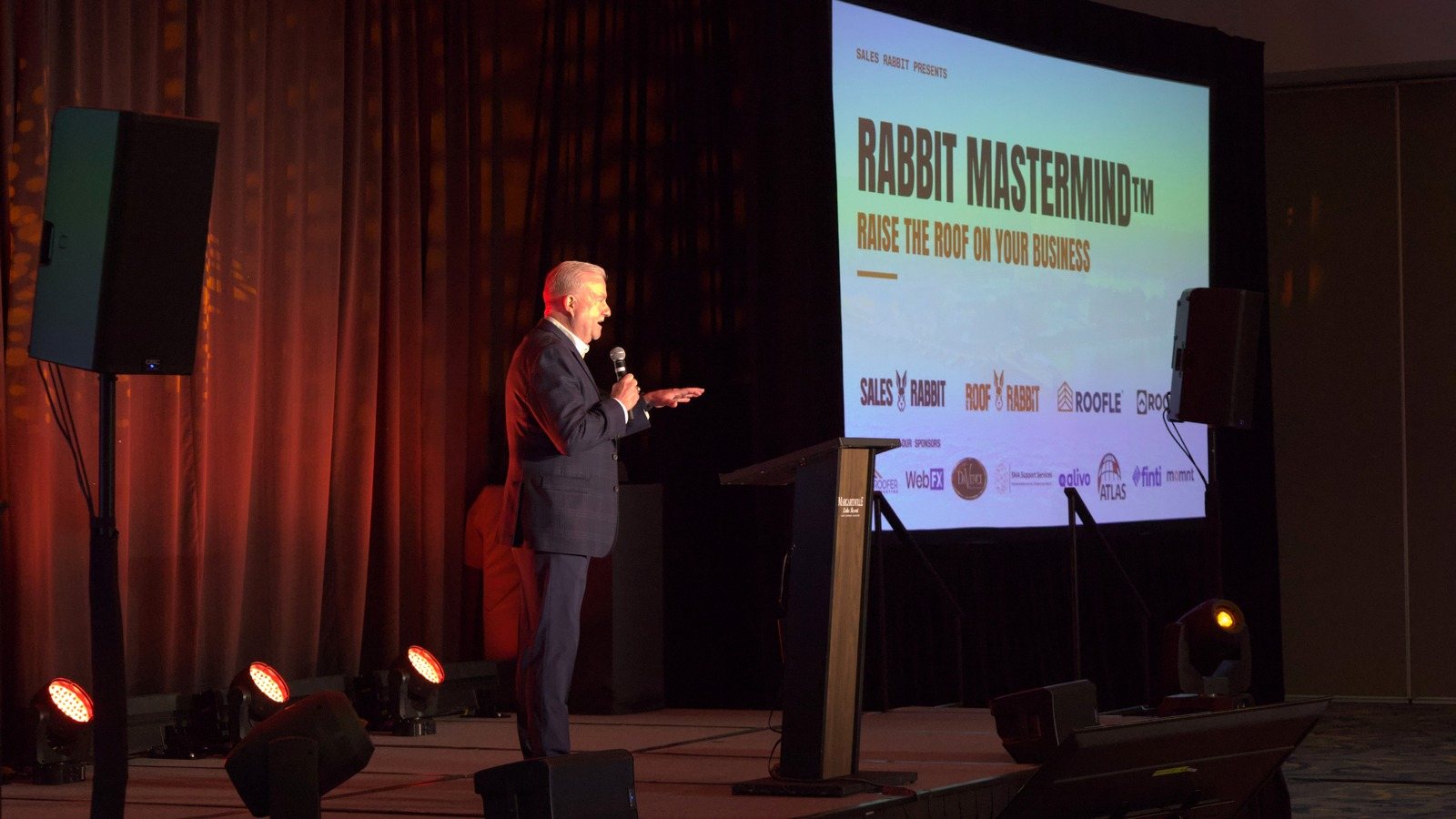
That’s what we built Rabbit Mastermind™: Raise the Roof on Your Business around. Sales Rabbit brought roofing business owners together November 16–18, 2026, at Margaritaville Lake Resort on Lake Conroe, Texas. Alongside the sessions, everyone worked through a printed workbook, and in one of the first pages we admitted something up front: “You’ll hear a lot of good ideas over the next three days. Unfortunately, most of them will leave your head a week from now, which is why this book exists.”
We asked each owner to write down the one problem they most wanted help with. By Wednesday afternoon, we asked them to turn that problem into three fixes for the next 90 days, each with a name and a due date. A good idea without either has a reliable home. It’s in the notebook under last year’s good ideas.
Here’s how the three days went, and what you can borrow without making the trip.
Monday: String Lights, a Thatched Pavilion, and Bunny Ears
We opened Monday evening outdoors, away from the ballroom where the sessions would run, under a white tent with string lights along the roofline. A thatched pavilion glowed behind it as the sun went down. At check-in, orange-and-black lanyards lay across the table, and the two people behind it wore bunny ears. One pair was pink. The other lit up purple. It was the right look for a Rabbit event.

Near the buffet, two guests stood with their arms around each other’s shoulders, smiling. BēST Roofer Marketing sponsored the evening, so our thanks to them for the tent and the welcome. Our team had done a lot of this work through screens. Standing under that tent with customers and sponsors was a chance to hear what owners were dealing with before we got into the sessions.
Tuesday: First, Can Anyone Find You?
Tuesday’s theme was “Build Your Growth Engine.” By the first session, orange-red light washed the ballroom ceiling and round tables filled the floor. In a corner stood the booth for Roof Rabbit, the roofing machine we demoed at the keynote later that day. Its backdrop carried our shorthand for speed from first pitch to final payment: Pitch first. Quote first. Paid first. The table was stacked with black T-shirts printed with an orange bunny, and two of our team sat behind open laptops.
WebFX, a sponsor and the company behind our first speaker, kept the room fed at breakfast both mornings. Then came the first question of the day: where does a homeowner start?

Four Searches on Your Own Company
Brandon Collins of WebFX opened with search. He walked us through five places AI tools can pull information about your business from: your website, your Google profile, reviews, directories, and mentions on sites like Reddit and Yelp. Messy or outdated information can work against you long before a homeowner calls.
The workbook turned that into an exercise called “Look for Your Company the Way a Homeowner Would.” Run four searches. Start with “roofer in Houston” and “roof repair in Houston,” swapping in your own city. Then search for your company name. Finally, ask an AI tool, “Who can replace a roof in Houston?” The workbook asks whether you showed up and what needs work.
The last question is the one that stings: what did the search results or the AI assistant get wrong or leave out about your company? Grab your phone, run the four searches for your own city, and write down what comes back. Thank you, Brandon, for starting the room where the homeowner starts.
Slow Weeks, and a Slide About Eating Together
Bruce Leffler of BēST Roofer Marketing started with a question every roofer knows: what does your lead flow look like in the slow weeks?
In the first, calls came in after a mailer, but nobody could tie any of them to a signed job. In the second, an interested homeowner went quiet during follow-up. Before you spend another dollar getting the phone to ring, find out where your last signed job came from and what happened to the leads you already paid for. Start with one signed job and one lead that went quiet. See how far back your team can trace each one.
One of Bruce’s slides was titled “Everybody Eats. Everybody Contributes.” It showed a group toasting at Topgolf and laid out a team reward with two conditions. Every eligible salesperson closes at least one qualifying deal, and the team hits its stretch target. That gives your strongest producers a reason to help the rep who’s still working on their first deal. Thank you, Bruce, for an idea an owner can take back to a crew.

A Kids’ Basketball Game Next to the NBA
Chuck Thokey of Top Rep took the stage at noon with “Leading the Business Beyond the Day-to-Day.” His slide put two pictures side by side under the title “Recreation League vs Professional.” One showed a kids’ basketball game. The other showed NBA players.
This is where the workbook got practical. What comes to you every day that someone else could own? The printed example is one most owners will recognize: a change order waits for your sign-off while you’re on a job site.

A page in the workbook called “Who Decides” had you list the decisions that reach you, who makes them today, who could make them, and what they’d need from you. Below it sat the question I’d put on the wall of every roofing office: what would break first if you were gone for a week?
At 4pm, the Roof Rabbit Keynote
Speed was a thread through the day. Every time you take an unnecessary step out of the job, you give your team time back. The booth backdrop put it in three phrases: Pitch first. Quote first. Paid first.

We kicked off the keynote with the story of Roof Rabbit. We took what SalesRabbit, RoofLink, and Roofle each do well and brought those capabilities onto one foundation. We built AI into that foundation from the start and designed it so job data stays consistent from one step to the next. Then our CTO, Michael Archibald, took it from there with a live demo on the big screens.

I told the room what I believe we owe contractors as a partner. The technology should be simple to use and earn its place in the workday. If AI can save your team time on a real job, that’s worth talking about.
Afterward, one attendee told us the demo was phenomenal. A couple of people liked the idea of doing the work in one place instead of paying for and keeping up with separate apps. Another told us they were excited about the reporting.
Our goal with Roof Rabbit is to save you enough time to grow your business and make it home for dinner.
Try this with your office manager. Pick one job and count the apps, spreadsheets, and logins it touches between first knock and final payment.
Tuesday Night: Pickleball, Dinner, and Karaoke
Alivo, the company of Wednesday’s speaker Michael Gogan, sponsored the pickleball tournament. Two courts glowed royal blue under the lights, guests lined the fence, and fist bumps went across the net.

Dinner followed, then karaoke at the Boathouse. A woman in a striped sweater sang in shoes with glowing blue-green soles. At one point, four men crowded the stage with their arms up. We learned that confidence is transferable from roofing to karaoke. Pitch remains a separate issue.
Wednesday: Now Make It Run Without You
Wednesday’s theme was “Build a Business That Runs Beyond You.” Tuesday asked where growth gets stuck. Wednesday asked what keeps working when you step away. The ballroom went violet when Michael Gogan took the stage.
Two Numbers: How Fast You Answer and How Fast You Get Paid
Michael Gogan of Alivo led Practical AI for Roofing Companies. Jake Brydon of Heritage Roofing covered Protecting Margin and Getting Paid. Between them, they gave owners two numbers worth checking back home: how long it takes to answer a lead and how long it takes to get paid.

The Practical AI workbook page was called “Stop the Shop: The First-Touch Planner.” The exercise asked owners to look at their first response from the homeowner’s side. How quickly do you answer? Can you show work you’ve done nearby? Can the homeowner book an appointment while they have you?
Try it after hours. An instant “we’ll be in touch” is a fast way to confirm that someone will, at some point, be in touch.
Jake opened his session with a slide showing a steam locomotive with AI painted on the front and a cowboy leaning out of the cab. His point was that the train had left the station. The workbook brought it back to a number any owner can pull. How many days passed between finishing your last paid job and receiving the final payment?

The “Follow One Job” exercise had you list every step between signed and paid. The printed example was blunt: “The roof was finished, and the final invoice sat on a desk for weeks.” Your crew finished the roof. The invoice took a longer vacation than anyone on payroll.
What Keeps Allowing It, and the Steps Only You Can Do
At noon, the “Find the Operational Gaps” table workshop asked you to pick one problem: a task that gets stuck, a job that earns less than it should, or a payment that runs late. Then came the question on our team’s slide: what keeps allowing it to happen?
The conversation at the tables was part of the work. You could ask another roofer how they’d handled the same problem and hear where their first attempt fell apart. That’s a good way to spot the part you’ll need to account for back home.
After lunch came “Building a Sales Team That Can Grow With You.” One slide read, “Hire with intention. Coach with consistency. Set and uphold the standard. Build capacity.” The workbook had you write your sales process on one page and mark every step you handle yourself. Pick one a sales lead could take over and tell them what a good result looks like.

Wednesday Night: The Big Hare ’80s Party
Wednesday night closed with the Big Hare ’80s Party. A cardboard DeLorean sat onstage with a giant inflatable guitar and a MIX TAPE cassette at its feet. Guests came in leg warmers, neon visors, and patterned jumpsuits. At one point, a man picked up the cardboard car and walked around holding it out in front of him.

Atlas sponsored the party, so the workbooks got a night off.

The People Behind the Room
Attendees told our team the workbooks helped them put the sessions to use. They liked being able to ask speakers questions and work through real problems at their tables. I appreciated how candid the owners were with one another. It takes some trust to tell a room full of people where your business keeps getting stuck.
Thank you to the speakers who made time for those conversations, the sponsors who helped bring the event together, and the Sales Rabbit team who checked people in, hosted tables, ran the stage, and set the room. After doing so much of the work through screens, three days together were a highlight for our team.
Rabbit Mastermind™ FAQ
What was Rabbit Mastermind™?
Rabbit Mastermind™ was a three-day event for roofing leaders, presented by Sales Rabbit. It ran November 16–18, 2026, at Margaritaville Lake Resort on Lake Conroe, Texas. Owners worked through problems from their own businesses in workshops and table discussions, using a printed workbook to build a 90-day plan.
What were the themes each day?
Tuesday was “Build Your Growth Engine,” covering search visibility, consistent lead flow, and leading the business beyond the day-to-day. Wednesday was “Build a Business That Runs Beyond You,” covering how fast you answer, how you get paid, and how to build a sales team that can grow with you.
What was the Roof Rabbit keynote about?
We talked about what slows a roofing job down between the first lead and the final payment. Roof Rabbit brings the capabilities of SalesRabbit, RoofLink, and Roofle onto one foundation, with AI built in from the start and job data that stays consistent as the work moves forward. Michael Archibald, our CTO, followed with a live demo.
To see Roof Rabbit for yourself, book a demo at roofrabbit.ai.
Missed Rabbit Mastermind™? Here’s What You Can Still Do.
Run the four searches in your own market. Time your first response after hours. Trace your last paid job from the day your crew finished to the day the money came in.
Then do the last workbook exercise. Pick one problem your team keeps working around. Write down three fixes you can make in the next 90 days. Put a name and a due date next to each.
To see how Roof Rabbit handles the job from first lead to final payment, book a demo.
So, what would break first if you were gone for a week?


You must be logged in to post a comment.